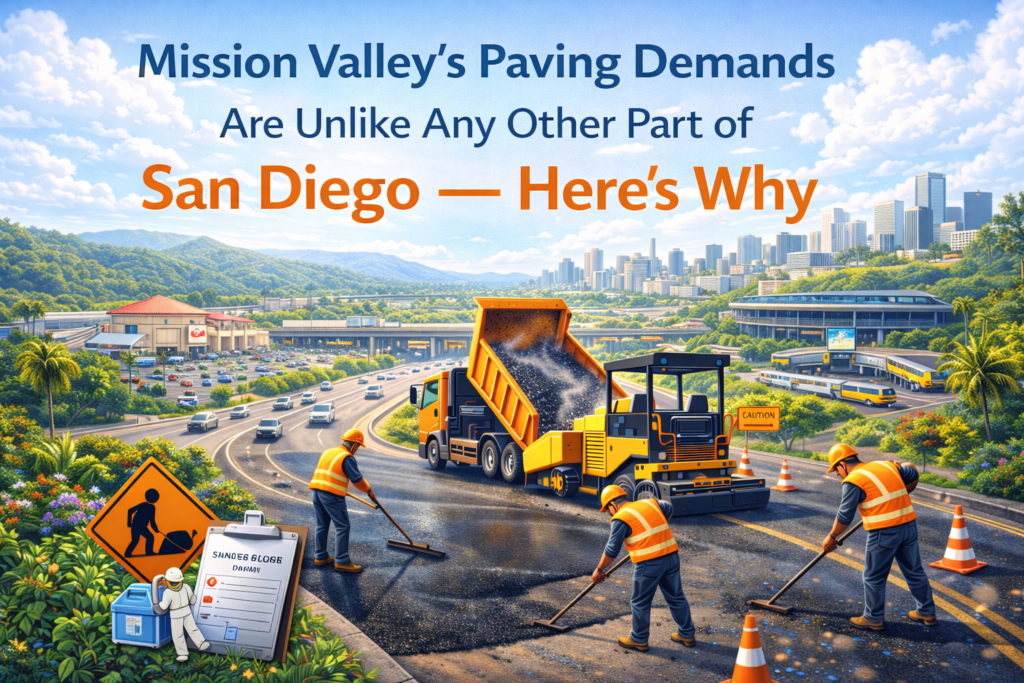
If you drew a straight line through the geographic and commercial heart of San Diego, it would run right through Mission Valley. Sitting in a natural floodplain carved by the San Diego River, Mission Valley is the region’s undisputed hub of retail, hospitality, healthcare, and high-density residential development. It’s home to some of San Diego’s largest shopping centers, a dense corridor of hotels and motels, major medical campuses, sports facilities, and thousands of apartment units that have multiplied rapidly over the past two decades.
And underneath all of that activity holding up the parking lots, access roads, loading zones, and driveways that keep it all functioning is asphalt. Miles and miles of it, much of it aging, heavily trafficked, and badly in need of attention.
If you manage or own commercial property, a shopping center, an apartment complex, a hotel, or any other high-use facility in Mission Valley, understanding the specific demands your environment places on pavement and working with the right Asphalt Contractor Mission Valley — is one of the most important maintenance decisions you can make.
Mission Valley’s Unique Paving Environment
Mission Valley is fundamentally different from every other San Diego neighborhood discussed in this series. It’s not a beach community with salt air and sandy soil. It’s not a historic hillside neighborhood with tree roots and steep driveways. Mission Valley is a high-volume, commercially intensive, flood-prone valley corridor — and each of those characteristics creates its own set of paving challenges.
Flood Zone Reality
Mission Valley sits at the bottom of a natural river valley, and the San Diego River runs directly through it. The valley has a long history of flooding, and while significant flood control infrastructure has been built over the decades, portions of Mission Valley remain in FEMA-designated flood zones. This matters enormously for asphalt maintenance because repeated inundation — even shallow flooding that doesn’t make the news — is extraordinarily destructive to pavement. Water that saturates the subbase softens and destabilizes the material that supports the asphalt above it, leading to settlement, cracking, and base failure that can happen surprisingly quickly after a major rain event.
Property owners in flood-prone sections of Mission Valley need contractors who understand stormwater management and drainage engineering, not just surface paving. Getting water off and away from paved surfaces — and preventing it from infiltrating the subbase — is a critical design consideration that should inform every paving decision here.
Extreme Vehicle Loads
Mission Valley is dominated by large-format retail, distribution, healthcare, and hospitality uses — all of which generate heavy vehicle traffic that puts tremendous stress on pavement. Delivery trucks servicing the major retailers along Friars Road and Mission Center Road, ambulances and medical transport vehicles at the hospital campuses, tour buses and shuttle vans at the hotel corridor, and the constant flow of heavy SUVs and pickup trucks in large shopping center parking lots all impose loads that standard residential pavement design simply isn’t built for.
Commercial asphalt in Mission Valley needs to be specified with higher traffic loads in mind — thicker pavement sections, stronger base courses, and mixes designed for heavy-duty applications. Contractors who routinely work on residential projects and treat commercial work the same way will underbuild for these conditions, producing pavement that fails prematurely under Mission Valley’s load demands.
Heat Island Effect
Mission Valley sits in a natural bowl that traps heat. Unlike coastal communities that benefit from ocean breezes and marine layer cooling, Mission Valley regularly experiences temperatures several degrees higher than the coast — sometimes dramatically so on hot summer days. This heat island effect accelerates asphalt oxidation and softening. Asphalt that gets very hot in summer can rut or deform under heavy vehicle loads, particularly in areas where vehicles stop and turn frequently, like parking lot entry and exit points, drive-throughs, and loading dock approaches. Specifying the right asphalt mix for high-temperature performance is critical in Mission Valley in a way it simply isn’t in cooler coastal neighborhoods.
High-Volume Parking Lot Demands
Mission Valley’s retail corridor includes some of the highest-traffic parking lots in San Diego County. Fashion Valley Mall, Mission Valley Center, Hazard Center, and numerous power centers and strip malls draw millions of vehicle visits annually. Parking lots of this scale and usage intensity require a fundamentally different maintenance approach than a small commercial lot or a residential driveway — larger equipment, phased work plans to keep portions of the lot operational, coordinated scheduling with tenants and property managers, and more frequent maintenance cycles.
The Commercial Focus: Asphalt Services for High-Use Properties
The vast majority of asphalt work in Mission Valley is commercial in nature, and the services that matter most reflect that reality.
Large-Scale Parking Lot Rehabilitation
For shopping centers, hotel properties, and medical campuses with extensive parking infrastructure, comprehensive rehabilitation is often the right approach after years of deferred maintenance. This process typically begins with a full pavement condition assessment — mapping crack patterns, identifying base failure zones, evaluating drainage performance, and quantifying the extent of surface oxidation. From that assessment, a phased rehabilitation plan can be developed that addresses the most critical areas first and spreads the investment over time in a way that manages costs while progressively improving conditions.
The rehabilitation itself might involve full-depth reclamation in the worst sections (where the existing pavement and base are ground up and recompacted as a new base course), overlay of areas with sound bases but deteriorated surfaces, and targeted crack repair and sealcoating in sections that still have meaningful remaining life. Getting this triage right — and not spending money on full replacement where an overlay will suffice — is where a contractor’s expertise in pavement assessment really pays off.
Asphalt Milling and Overlay
For large commercial lots, milling — the process of grinding down the top layer of existing asphalt to a consistent depth before installing a new surface course — is often the preferred rehabilitation technique. It removes the deteriorated surface material while preserving a sound base, maintains existing grades so drainage isn’t disrupted, and produces a uniform surface profile for the new overlay. Unlike simply paving over an existing surface (which can create edge buildup problems over multiple cycles), milling produces cleaner transitions and more durable results.
Drive-Through and High-Stress Zone Repair
Fast-food restaurants, pharmacies, coffee shops, and banks with drive-throughs are common throughout Mission Valley, and their pavement experiences concentrated stress in ways that the rest of their parking lots don’t. The queuing areas where vehicles idle, the turning radii where customers maneuver, and the window approach zones where vehicles slow and accelerate repeatedly all develop rutting and surface fatigue much faster than open parking field areas. These zones often need more frequent repair and may benefit from a polymer-modified asphalt mix that is more resistant to deformation under repeated loading and high temperatures.
Loading Dock and Heavy Access Road Paving
The distribution centers, big-box retailers, grocery stores, and food service operations throughout Mission Valley all have loading dock areas and heavy truck access roads that require pavement engineered for axle loads far exceeding typical passenger vehicle standards. These areas need greater pavement thickness, stronger base courses, and often concrete aprons at the dock faces where truck axle loads are concentrated. A contractor without experience in heavy-duty commercial paving will underspecify these areas, leading to premature failure that can be both costly and disruptive to business operations.
Stormwater Management Integration
California’s Municipal Separate Storm Sewer System (MS4) regulations require commercial property owners to manage stormwater runoff from their properties. For large paved surfaces in Mission Valley, this means ensuring that pavement grading directs runoff to appropriate collection and treatment systems, that drain inlets are properly maintained and not obstructed by pavement failures, and that any paving work doesn’t create new runoff pathways that violate stormwater permits. Contractors working on commercial properties in Mission Valley should be familiar with these requirements and should incorporate stormwater considerations into every project.
Parking Lot Striping, Signage, and ADA Compliance
California’s ADA requirements for commercial parking lots are detailed and strictly enforced. The number of accessible stalls required scales with total lot size, accessible stalls must meet specific dimensional requirements, accessible routes must connect parking to building entrances, and signage must meet specific standards. For large Mission Valley commercial properties, getting this right — particularly after a resurfacing project that requires complete re-striping — is not optional. Contractors with commercial parking lot experience will be familiar with the current California Building Code requirements for accessible parking and can ensure your lot is fully compliant after any significant paving work.
Scheduling Strategy for Commercial Properties in Mission Valley
For busy commercial properties in Mission Valley, scheduling is one of the most logistically complex aspects of any paving project. Unlike a residential driveway where the homeowner can simply park on the street for a day, a major retail parking lot or hotel property can’t simply shut down.
The most effective approach for large commercial properties is phased construction — dividing the lot into sections and working on one section at a time while keeping the rest operational. This requires careful coordination with the property manager, tenants, and customers, clear temporary signage and traffic direction, and a contractor experienced in managing active commercial sites safely and efficiently.
Timing matters enormously in Mission Valley’s retail-driven environment. Major shopping centers should avoid scheduling significant paving work during the holiday retail season (November through January), the back-to-school period (late July through mid-August), and any other peak traffic periods specific to their tenant mix. Hotels need to work around peak occupancy periods. Medical facilities need to ensure emergency vehicle access is never compromised.
The best commercial paving contractors in Mission Valley will work with you to develop a project schedule that minimizes business disruption, protects tenant relationships, and delivers the project efficiently. This kind of project management sophistication is a meaningful differentiator between contractors who work primarily on commercial projects and those who primarily serve residential clients.
Why Deferred Maintenance Is Especially Costly in Mission Valley
In residential settings, deferred asphalt maintenance is a problem — but the consequences unfold relatively slowly and affect primarily the property owner. In Mission Valley’s commercial environment, the consequences of deferred maintenance compound much more quickly and affect a wider set of stakeholders.
Tenants in a shopping center with a deteriorated parking lot notice — and complain. Customers who damage tires in potholes or trip on cracked surfaces file liability claims. Healthcare facilities with failing loading dock pavement face operational disruptions that go far beyond inconvenience. Hotels with crumbling entry drives send a message of neglect that contradicts whatever premium they’re trying to charge for their rooms.
And in California’s aggressive litigation environment, a property owner who fails to maintain safe pedestrian and vehicle pathways on their commercial property is exposed to significant liability. Slip-and-fall and trip-and-fall claims arising from pavement defects are common, and courts consistently look at whether the property owner knew — or should have known — about the hazard. A documented maintenance program, including regular inspections and prompt repair of identified defects, is one of the best protections a commercial property owner can have.
The cost of keeping pavement in good condition in Mission Valley is real but manageable. The cost of ignoring it until failures become acute — and dealing with the combined expense of emergency repairs, tenant complaints, liability claims, and loss of business — is far higher.
Choosing the Right Commercial Paving Partner in Mission Valley
Not every asphalt contractor is equipped for Mission Valley’s commercial demands. The right partner for properties in this corridor brings genuine commercial project experience, the equipment capacity for large-scale work, familiarity with California’s commercial pavement regulations, and the project management capability to execute complex, phased projects on active commercial sites.
Ask any contractor you’re considering about their commercial project portfolio specifically — not just their overall experience. Find out how they handle scheduling and tenant communication on multi-phase projects. Ask how they specify pavement thickness and mix design for high-traffic commercial applications. Find out whether they’re familiar with MS4 stormwater requirements and ADA compliance standards for commercial parking lots.
The answers to these questions will quickly reveal whether you’re talking to a contractor who genuinely understands Mission Valley’s commercial paving environment or one who’s comfortable with driveways and small lots but is out of their depth on a 200-space shopping center rehabilitation.
For commercial and institutional property owners ready to take their pavement maintenance seriously, a qualified Asphalt Contractor Mission Valley is the right place to start. Get a professional assessment, understand what your pavement actually needs, and build a maintenance plan that protects your investment and keeps your tenants and customers satisfied.
Frequently Asked Questions (FAQs)
Q: My shopping center parking lot has sections that are completely failed and other sections that still look reasonable. Do I need to replace everything at once?
A: No — and in fact, a phased approach is usually both more practical and more cost-effective for large commercial lots. A professional pavement condition assessment will map out the severity of deterioration across your entire lot and help prioritize which sections need full-depth repair or replacement now, which can be addressed with overlay or crack repair, and which can be maintained with sealcoating for another few years. This kind of triage approach lets you allocate your maintenance budget where it delivers the most value and spread the total investment over time rather than facing one enormous capital expense all at once.
Q: How does Mission Valley’s heat affect asphalt performance differently than other San Diego neighborhoods?
A: The valley’s heat island effect means pavement here reaches higher surface temperatures than coastal or elevated neighborhoods. When asphalt gets very hot, the binder softens, which makes the surface more susceptible to rutting — permanent deformation from vehicle loads — particularly in areas of concentrated stress like drive-throughs, turning lanes, and loading dock approaches. Specifying a polymer-modified asphalt binder, which maintains stiffness at higher temperatures, is one way to address this. Specifying the correct pavement thickness for expected traffic loads is equally important. A contractor experienced in Mission Valley’s commercial environment will know to design for these temperature conditions rather than using a standard residential mix.
Q: My property is near the San Diego River. Should I be concerned about flood damage to my pavement?
A: If your property is in or adjacent to a FEMA-designated flood zone in Mission Valley, flooding is a real risk that should inform your pavement maintenance strategy. Pavement that has been inundated — even if it looks okay on the surface immediately afterward — may have a compromised subbase that will fail under traffic load once the moisture redistributes. After any significant flooding event, having your pavement professionally assessed before assuming it’s still sound is a worthwhile precaution. On the prevention side, ensuring proper drainage design and subbase composition can reduce the extent of flood damage when water events do occur.
Q: We have a fast-food drive-through at our Mission Valley property that develops ruts every couple of years. Is there a permanent solution?
A: Rutting in drive-through lanes is an extremely common problem in Mission Valley’s heat and with the concentrated vehicle loading these zones experience. The most durable solution combines two elements: using a polymer-modified or SMA (Stone Matrix Asphalt) mix that is specifically engineered to resist deformation at high temperatures, and ensuring the pavement section thickness is adequate for the load and thermal conditions. In some cases, concrete pavement at the highest-stress points — the window approach and any areas where vehicles queue with engines idling — is the most permanent solution, since concrete is far more rut-resistant than asphalt under these conditions. A contractor experienced in commercial drive-through paving can help you evaluate which approach makes the most sense for your specific site.
Q: What ADA requirements apply to our commercial parking lot in Mission Valley?
A: California’s ADA requirements for commercial parking lots are governed by the California Building Code, which adopts federal ADA standards with some California-specific additions. The key requirements include: a minimum number of accessible stalls based on total lot size (generally one accessible stall per 25 total stalls up to a certain threshold, with additional stalls for lots above that threshold), accessible stalls must be a minimum of 9 feet wide with an adjacent 5-foot access aisle (or 8 feet wide with an 8-foot aisle for van-accessible stalls), accessible stalls must be located on the shortest accessible route to the building entrance, accessible routes must have a maximum cross slope of 2%, and proper signage must be installed. After any resurfacing project, your contractor should re-stripe to current standards. For a definitive answer on your specific lot, consulting with your contractor and potentially a California-licensed accessibility consultant is advisable.
Q: How often should large commercial parking lots in Mission Valley be inspected and maintained?
A: For high-traffic commercial lots in Mission Valley’s demanding environment, a formal inspection at least once per year is advisable — ideally in the fall before the rainy season, so any drainage issues or developing cracks can be addressed before winter moisture makes them worse. Sealcoating cycles for commercial lots typically run every three to five years depending on traffic volume. Crack sealing should be done on an as-needed basis whenever cracks develop, rather than waiting for a fixed schedule. Striping typically needs refreshing every one to two years in high-UV environments. A preventive maintenance plan developed with your contractor — with scheduled inspections and a documented maintenance log — is the most cost-effective way to manage a large commercial lot and also provides valuable documentation in the event of a liability claim.
Q: Can I get an asphalt project done in Mission Valley during the rainy season?
A: Asphalt installation and sealcoating should not be done in wet conditions or immediately before expected rain — moisture interferes with adhesion and can prevent proper curing. San Diego’s rainy season typically runs from November through March, but actual rainfall events are intermittent rather than continuous. Many commercial paving projects proceed during this period by carefully monitoring weather forecasts and scheduling work during confirmed dry windows. Your contractor should be monitoring conditions closely and prepared to reschedule if rain threatens within 24–48 hours of planned work. Crack sealing and some cold-mix patching can be done in cooler, drier conditions that fall short of ideal hot-mix installation weather, allowing some maintenance work to proceed even in the cooler months.